Hostinger vs SiteGround: Where the Cheaper Host Actually Costs More
These two are usually shortlisted together because they look like the same product at different prices. They are not.
Hostinger competes on cost. SiteGround competes on support. At September 2026 prices the gap does not close over time: both entry plans renew well above their introductory rate, and SiteGround’s renews higher than Hostinger’s.
The comparison that matters
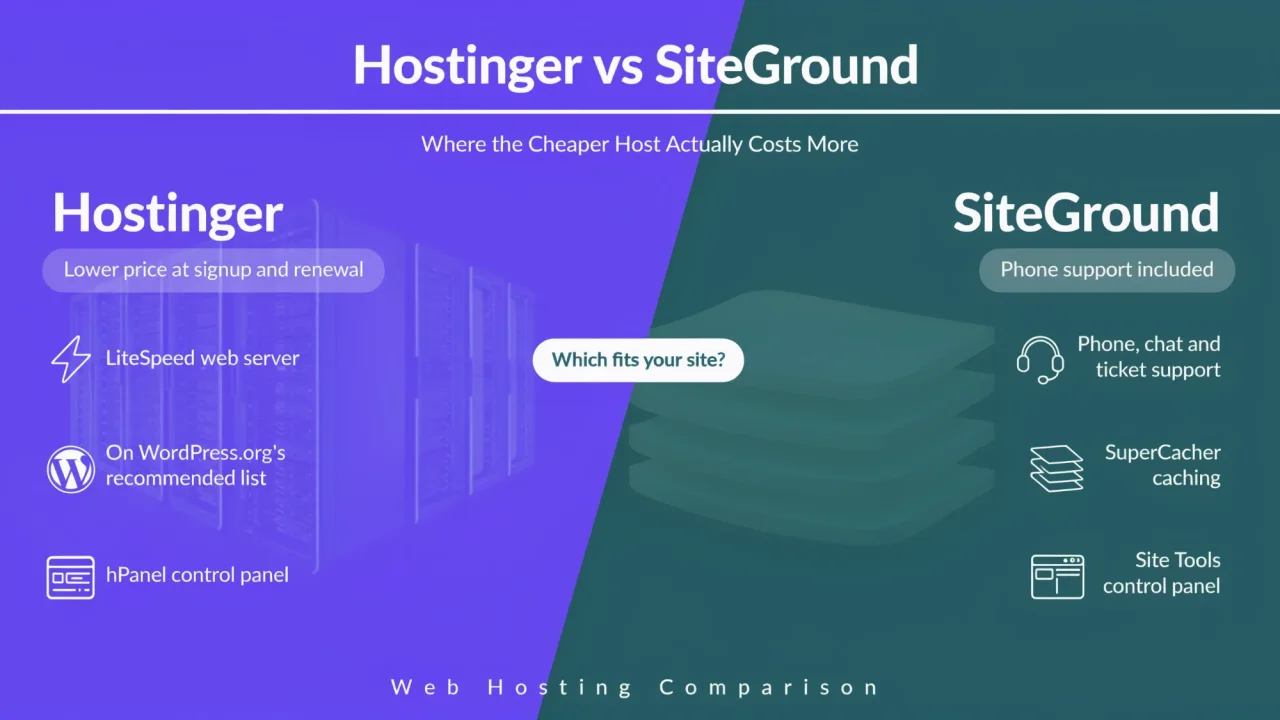
| Hostinger | SiteGround | |
|---|---|---|
| Positioning | Lowest entry cost | Support and platform reputation |
| WordPress.org recommended | Yes | No (removed in 2023) |
| Web server | LiteSpeed | Apache behind an Nginx reverse proxy |
| Control panel | hPanel (custom) | Site Tools (custom) |
| Renewal behaviour | Rises sharply from intro rate | Rises sharply from intro rate |
| Best fit | Budget-bound first sites | Sites where downtime has a cost |
Note the row that is identical: both renew well above the advertised rate. Hostinger is still the cheaper of the two at renewal.
Where Hostinger wins
Entry cost, and not marginally. For someone launching a first site with no revenue behind it, that difference is the difference between starting and not starting.
LiteSpeed is the other genuine advantage. Server-level caching on a shared plan is worth more than most of the features that appear on comparison tables.
Where SiteGround wins
Support, by reputation and by channel: SiteGround offers phone support alongside chat and tickets, while Hostinger offers chat and email only. When a site breaks and you do not know why, the difference between a host that resolves it and one that sends you a documentation link is not a line item — it is the entire value of hosting that week.
Where the cheaper host costs more
Three places, all invisible at checkout.
The first is downtime on a site that earns. An hour offline on a storefront costs more than a year of the price difference. We found no credible independent data showing either host goes down more often than the other, so the real question is how quickly you can get help when something breaks.
The second is your own time. Support that resolves an issue in one exchange versus three is hours you do not spend. Value those hours at anything above zero and the comparison shifts.
The third is migration. Choosing on entry price, outgrowing the plan, and moving in year two costs a migration you would not otherwise have paid for.
How to decide
Ask what an hour of downtime costs you. If the honest answer is nothing — a personal blog, a portfolio, a project not yet earning — Hostinger, and the saved money is real.
If the answer is a number, the difference stops being about hosting and becomes insurance, and SiteGround is the more defensible buy.
Bottom line
Neither is wrong. Hostinger is the better first host; SiteGround suits a site with something to lose, if phone support justifies its higher renewal price. Related reading: our Hostinger review, and DreamHost versus SiteGround.
Hosting prices change often and vary by term length and region. Figures are deliberately omitted here; check current pricing, and the renewal rate specifically, before buying.