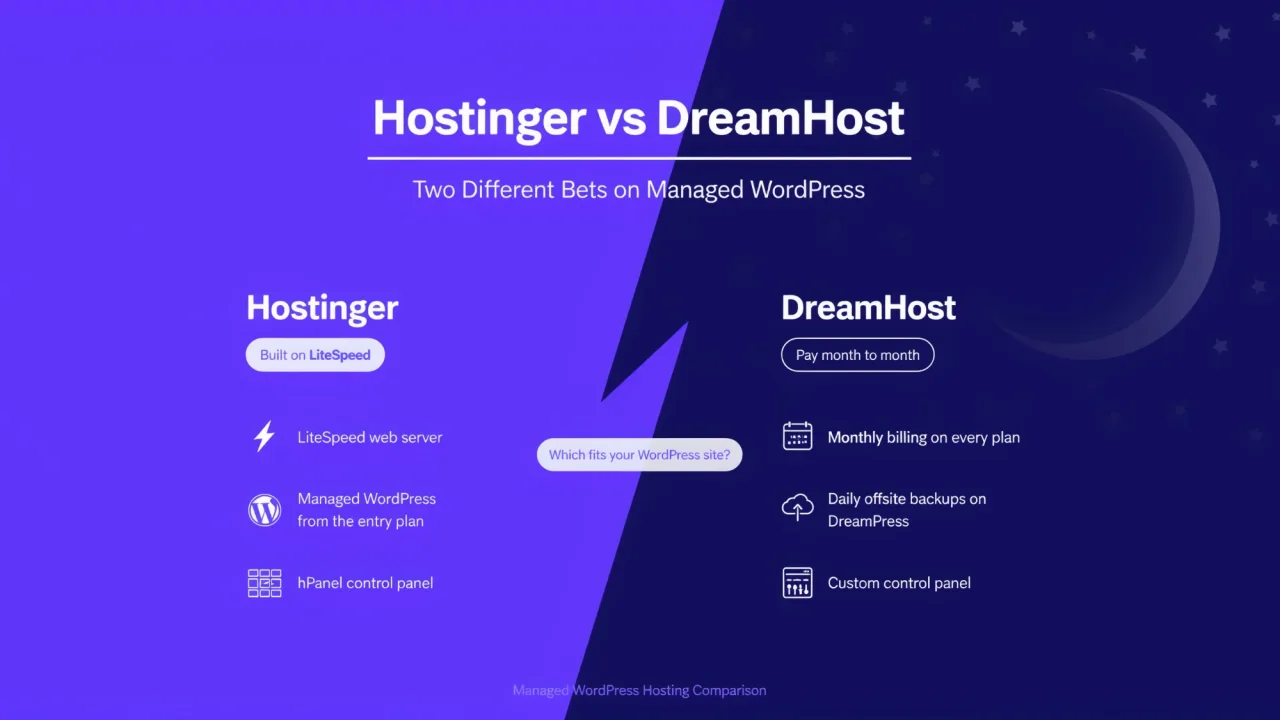
Hostinger vs DreamHost: Two Different Bets on Managed WordPress
Hostinger and DreamHost have more in common than either markets. Both sell managed WordPress hosting. Both run a panel of their own instead of cPanel. Both price on multi-year terms with a renewal jump.
They diverge on what they are betting the customer wants.
The two bets
| Hostinger | DreamHost | |
|---|---|---|
| The bet | Price wins the first site | Flexibility wins the considered choice |
| WordPress.org recommended | Yes | No (removed in 2024) |
| Managed WordPress product | Managed WordPress tiers | DreamPress |
| Refund window | 30 days | 30 days |
| Monthly billing | Available, at a much higher rate than long terms | Available on every plan |
| Control panel | hPanel | Custom panel |
| Domain privacy | Free on supported extensions | Free on supported extensions |
What "managed" actually means
Less than the word implies, and it varies by host. Broadly it covers server-level caching configured for WordPress, automatic core updates, and staging on the higher tiers.
It does not mean someone else maintains your site. Plugin conflicts, theme updates, broken layouts after an update and the consequences of a badly chosen plugin remain yours. Managed hosting manages the server, not the website.
Worth being clear about, because "managed" is frequently bought as though it means "handled."
Monthly billing is the sharpest difference
Both hosts refund within 30 days, the industry standard. DreamHost used to offer 97 days; its current terms set 30.
Thirty days barely covers a cautious migration, so billing matters more than the refund window here. DreamHost offers monthly billing on every hosting plan. Hostinger sells a one-month term too, but its lowest rates require a 48-month prepayment.
With month-to-month billing on every plan, DreamHost is unusually low-risk to try — and the ability to test a host properly is worth more than a modest discount. There is more on this in our DreamHost review.
Where Hostinger takes it
Cost, decisively, and LiteSpeed. On a shared plan, server-level caching is a meaningful performance advantage over a standard Apache stack, and it comes free with the platform rather than as an upsell.
If the budget is the constraint and the site is not yet earning, that combination is hard to argue against. Our Hostinger review covers what the entry tier includes.
The trust signal
Hostinger is on the WordPress.org recommended-hosting page. DreamHost was removed from it in December 2024.
Treat it for what it is: not a performance benchmark, but a short and stable list that a host cannot put itself on. For someone building a client site who may have to justify the choice later, that is worth something concrete.
How to choose
Take Hostinger if entry cost is the binding constraint, if you want LiteSpeed caching without paying for a premium tier, or if the WordPress.org listing carries weight in your decision.
Take DreamHost if you want to pay month to month while you test a host, or want DreamPress’s daily offsite backups and one-click staging.
Bottom line
Hostinger optimises for getting started cheaply. DreamHost optimises for being easy to leave, which is a strange thing to advertise and a genuinely good reason to trust a host. Pick the one whose bet matches your situation.
Hosting prices change often and vary by term length and region. Figures are deliberately omitted here; check current pricing, and the renewal rate specifically, before buying.