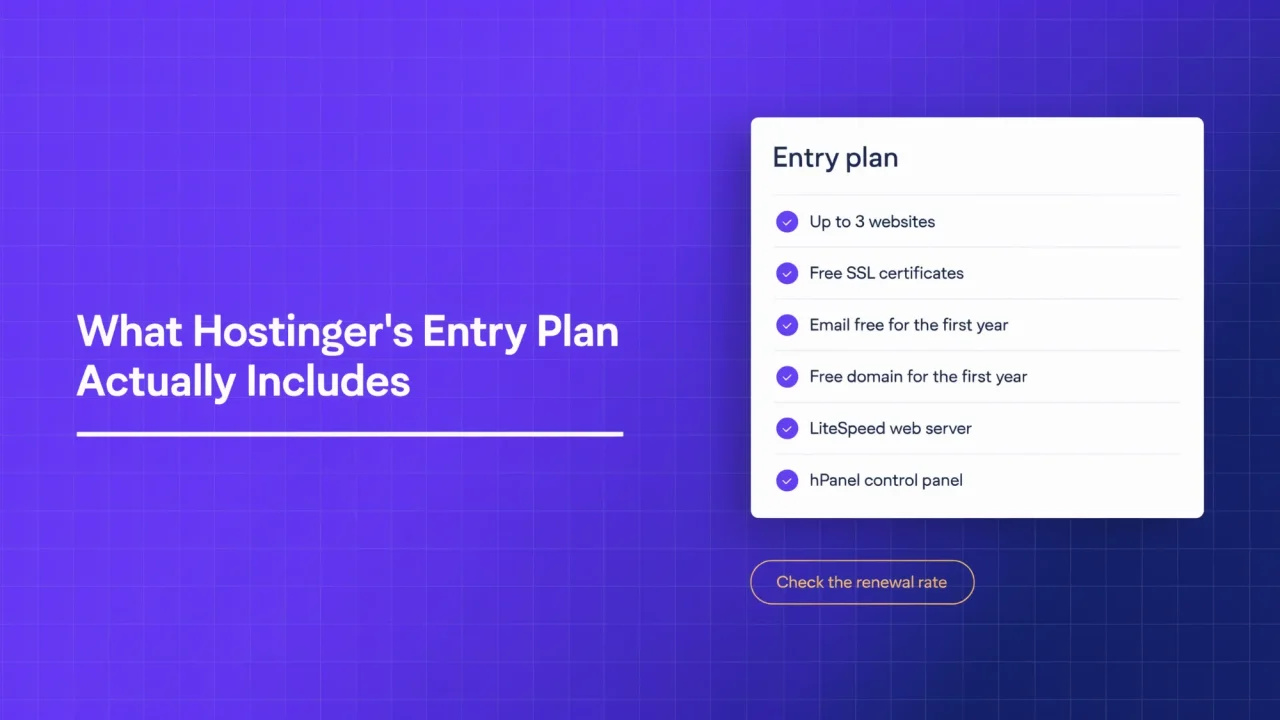
What Hostinger's Entry Plan Actually Includes
Hostinger competes on price, and it competes hard. That is the whole positioning, and it is worth being precise about what the low number buys.
The short version: the entry tier is genuinely usable for a small site, the advertised rate is a first-term rate, and the limits that bite are not the ones printed on the pricing page.
The advertised price is a first-term price
Hosting is sold on multi-year terms. The headline rate applies to the term you buy up front. Renewal is higher, often by a multiple.
This is industry-wide rather than a Hostinger quirk, and it is the single most common source of buyer's remorse in hosting. It also means the cheapest signup is frequently not the cheapest four-year cost.
Do the arithmetic before committing: find the renewal rate, multiply by the years you expect to stay, add the first term. That total is the real price. A host advertising twice the headline rate but renewing at a similar figure can easily win over five years.
What the entry tier genuinely covers
A free SSL certificate, which is table stakes now and should not be sold as a feature. Email for the first year, a website builder, one-click WordPress installation, and enough storage for a brochure site or a blog that has not yet found an audience.
For a first site, that is sufficient. Most people over-buy hosting at the start, then discover the constraint was never disk space.
The limits that actually bind
Not storage. It is almost never storage.
Shared hosting divides one machine among many accounts, and the real ceilings are concurrent visitors, CPU time and the number of simultaneous processes your site is allowed. A WordPress install running a page builder and a dozen plugins consumes far more of those than a static brochure site, and it will hit the ceiling long before it fills the disk.
The symptom is not an error message. It is the site becoming slow specifically when several people arrive at once — which is the moment it matters most.
Entry tiers also cap the number of websites and, on the cheapest plans, the number of email accounts. Check those against what you actually intend to run rather than against what sounds generous.
LiteSpeed rather than Apache
Hostinger runs LiteSpeed. Most budget shared hosting runs Apache.
For a WordPress site the practical consequence is the LiteSpeed Cache plugin, which does server-level caching rather than caching from inside PHP. That is a real performance difference on a shared box and it is free.
The catch is portability. Tune a site around LiteSpeed Cache and moving to an Apache or Nginx host means re-doing the caching layer. Not difficult, but not nothing, and worth knowing before you build around it.
hPanel, not cPanel
Hostinger built its own control panel. If you have used cPanel anywhere else, expect to relearn where things live — there is a fuller breakdown in our piece on what hPanel changes for a cPanel user.
DreamHost made the same choice, and it produces the same trade-off: cleaner for beginners, friction for anyone with existing habits.
Where it sits against the alternatives
Hostinger is on the WordPress.org recommended-hosting page, one of three hosts listed there alongside Pressable and Bluehost. DreamHost and SiteGround used to appear on it and no longer do. The list is not a quality ranking, but it is a signal a host cannot award itself.
Alongside that listing, Hostinger offers a materially lower entry cost and LiteSpeed. For a first site on a real budget, that is a defensible trade. See also our DreamHost review and DreamHost versus SiteGround.
Who it suits
First sites, side projects, and anyone whose budget is the binding constraint. Sites that are unlikely to see sharp traffic spikes. Buyers willing to commit to a longer term to capture the low rate, having checked what renewal costs.
Who should look elsewhere
Anyone expecting bursty traffic on a shared plan. Agencies standardised on cPanel. Anyone who needs phone support, which Hostinger does not offer.
Bottom line
Hostinger delivers what it advertises at the entry tier. The things to check before buying are the renewal rate and the concurrency limits, and neither is on the front of the pricing page.
Hosting prices change often and vary by term length and region. Figures are deliberately omitted here; check current pricing, and the renewal rate specifically, before buying.