Brevo: Billing by Emails Sent, Not Contacts Stored
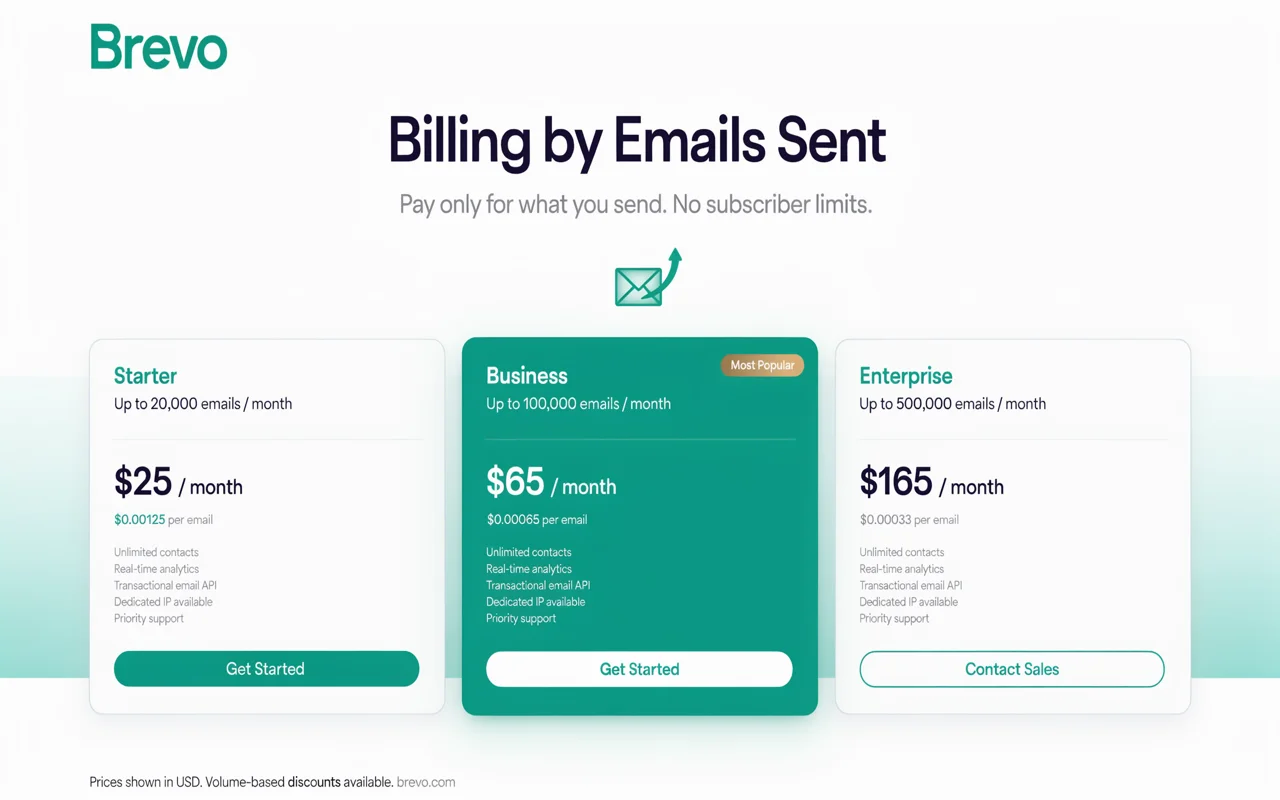
Brevo, formerly Sendinblue, prices on emails sent rather than contacts stored. Almost every competitor does the opposite.
That single difference determines whether it is cheap or expensive for you, and it is worth working out before looking at anything else.
The pricing model, and who it favours
Contact-based pricing charges for every address on your list, whether you mail it or not. Grow to fifty thousand subscribers and mail them twice a year, and you pay for fifty thousand contacts twelve months a year.
Send-based pricing charges for volume dispatched. The same list costs almost nothing to hold and is billed only when you actually use it.
Reverse the pattern and it reverses too. A small, engaged list mailed daily racks up sends against a contact count that would have been cheap elsewhere. Multiply your list size by your realistic monthly send frequency; that number, not your subscriber count, is what Brevo bills against.
Transactional email is included, and that is unusual
Password resets, order confirmations, shipping notices — transactional mail is a separate product and often a separate vendor for most stacks.
Brevo runs both marketing and transactional sending through one account, with an API and SMTP relay for the transactional side. For a small team that removes a whole integration and one monthly bill.
It also concentrates risk. Marketing and transactional mail share sending infrastructure, and reputation damage from a badly targeted campaign can reach the receipts your customers need to receive. Any provider mixing the two carries this; it is a reason to keep list hygiene tight rather than a reason to avoid the platform.
What else is in the box
SMS, WhatsApp messaging, a basic CRM, landing pages, forms, and automation workflows built on a visual branching editor. Segmentation on contact attributes and behaviour.
The automation builder handles the common shapes competently — welcome sequences, abandoned cart, re-engagement, date-triggered sends. It is not the deepest tool in the category, and teams running genuinely intricate lifecycle logic across many branches will find its ceiling.
Where it is thinner
The template editor is functional rather than pleasant. Building something visually distinctive takes longer than it does in tools that treat design as the product.
The integration ecosystem is smaller than the market leaders'. The major platforms are covered; the long tail of niche tools frequently is not, which means more work through an API or a middleware service.
Reporting answers the standard questions — opens, clicks, bounces, unsubscribes, revenue attribution. It does not go much past them.
Deliverability is mostly your job
No provider can rescue a bad list. Authenticate your domain properly with SPF, DKIM and DMARC, warm up gradually rather than dispatching to a cold list of fifty thousand on day one, and remove non-openers on a schedule.
Providers supply infrastructure and reputation management. Sending behaviour is what actually determines whether mail lands, and that is set by you.
Who it suits
Businesses holding a large list they mail occasionally. Teams wanting marketing and transactional email in one account. Anyone who wants SMS alongside email without a second vendor. Cost-sensitive operations where the contact-based model has become the largest line item.
Who should look elsewhere
Teams whose priority is template design polish. Anyone dependent on a wide integration catalogue. Operations running complex multi-branch lifecycle automation, where a specialist tool will pay for itself.
Bottom line
Brevo is a competent all-rounder whose pricing model is its actual argument. If you hold a large list and mail it rarely, that model is a material saving and the reason to look. If you mail a small list constantly, the same model works against you, and no other feature here will compensate.